

Scrum Teams follow certain rules and ceremonies. The same goes for backlog estimations to ensure equal evaluation patterns at all times. Those rules need quick and easy checkpoints to protect the effectiveness and quality of final estimates.
In this article, I would like to share a simple checklist for effective estimations that will support Scrum Masters and Product Owners who estimate together with the Development Teams. Why is this list helpful?
- If you are a Scrum Practitioner - this list will help you verify if all of the important parts of Scrum Rituals are followed. Use this checklist, test and tweak your processes if needed to make your team more effective during estimation sessions;
- If you are part of a team that is new to Agile and just starting to implement agile estimations sessions, the list will be a good starting point for putting the estimation process in place.
The checklist is not a procedure, guideline, or recipe that will fit all needs - check it, adjust it, and I hope you will find it useful. Let's roll, then!
Your Agile estimation checklist served
The first thought that could probably pop into your mind is that you don't want to miss any part of the process and detail. Also, you want to ensure that your team consistently delivers whatever has been promised. To achieve this, you need accurate estimates that will enable your team to commit realistically to what they will deliver.
Estimations, when done with constantly changing approaches, might impact this accuracy and confidence in what can be delivered. Suppose your estimations are not reliable and realistic. In that case, it will backfire on your team or even the whole company during the planning and management phase, which may, in the end, mean that your client or stakeholder will be unsatisfied with the final outcomes.
The estimations checklist will help you keep simple rules in place when the environment is rapidly changing and evolving. Especially when being under time pressure, we end up cutting estimation quality.
But before we dive into the checklist itself, I want to bring up some of the essential rules of estimation meetings that will allow teams to move efficiently through the estimations phase and set roles that each meeting member needs to play.
Rules of agile estimation meetings:
- Scrum Master is a facilitator of this meeting and should not be taking part in the discussion, but he or she needs to follow the discussion and be able to bring it on the right rails;
- Product Owner prepares and explains Backlog Items for the estimation;
- Only the development team members can estimate and discuss Backlog Item efforts;
- The Product Owner prioritizes the Product Backlog based on business value, and priorities are aligned with business needs;
- The estimation method is chosen by the team upfront and known by all team members;
- The estimation session should be ideally separated from the planning session;
- The Sprint Backlog Estimation session should be timeboxed, ex., 2 hours per 2-week plan (modify it with the same relation if your typical Sprints are different).
Now that we recalled the basic rules that should be followed while estimating, let's look at the promised checklist. It was divided into four sections to cover the whole cycle of the estimation process.
Agile estimation checklist for Scrum Teams
BEFORE THE ESTIMATION SESSION:
- Make sure that the Product Backlog is in line with the Product Roadmap and Product Vision;
- The team identifies Backlog Items that need to be clarified for the next estimation session if there is a need for it;
- Product Backlog should be refined before the Sprint estimation session;
- Product Backlog is prioritized BEFORE the estimation session;
- Product Owners should check User Stories statuses and ensure they satisfy the Definition of Read.
PREPARATION FOR THE ESTIMATION MEETING:
- All required participants are invited and confirmed meeting invitations (Product Owner, Scrum Master, Development Team Members);
- All members have access to Product Backlog during the meeting (crucial for Remote/Distributed teams);
- All participants know their roles and what's expected from them;
- Select a moderator responsible for keeping the meeting on the right rails.
DURING THE ESTIMATION SESSION:
- The Product Owner presents the goal of the estimation session or simply moves the Backlog Items that should be estimated to the top of the Backlog;
- The Product Owner is ready to explain the 'story' behind each User Story;
- The team reviews the list and asks for clarification if needed;
- If an Item is too large for the Sprint - the team decomposes it or moves to another Sprint;
- During the very first estimation session, the team chooses one of the Backlog Items and a set as a reference point;
- Each team member estimates the size of each Sprint Backlog Item one by one. Sometimes several rounds of estimates are run to reach a consensus;
- During each round, team members reveal the voting (if the estimates differ, the most contrary views need explaining by voters);
- The Product Owner finishes the meeting with a short wrap-up.
RESULTS OF ESTIMATION SESSION:
- Estimated Product Backlog Items;
- Backlog Items that used to be too big were decomposed or moved back to Product Backlog to be clarified;
- Estimated Backlog Items are available and visible to everyone in the organization;
- The Product Owner has a list of issues that must be clarified before the next estimation session.
As promised at the beginning of this post, here is a link to our checklist - open and free to use for you and your team. Feel free to adjust it to your needs.
How can Agile Poker for Jira help you with Backlog Estimation?
Most estimation methods probably have the same disadvantage - they are not based on clear data but mainly on the team's experience and collective thinking.
How to make your backlog estimations more reliable in the long run? Be consistent - use the same process and approach for your estimations - educate your team members based on your past estimations, and build confidence in your estimations in the future.
Agile Poker for Jira will help you keep the process, approach, and tool elements intact - and together with your team's time, effort, and experience, you're in for reliable backlog estimations.
Let's dive deeper into some examples from the above checklist to see how Agile Poker for Jira can support your estimations.
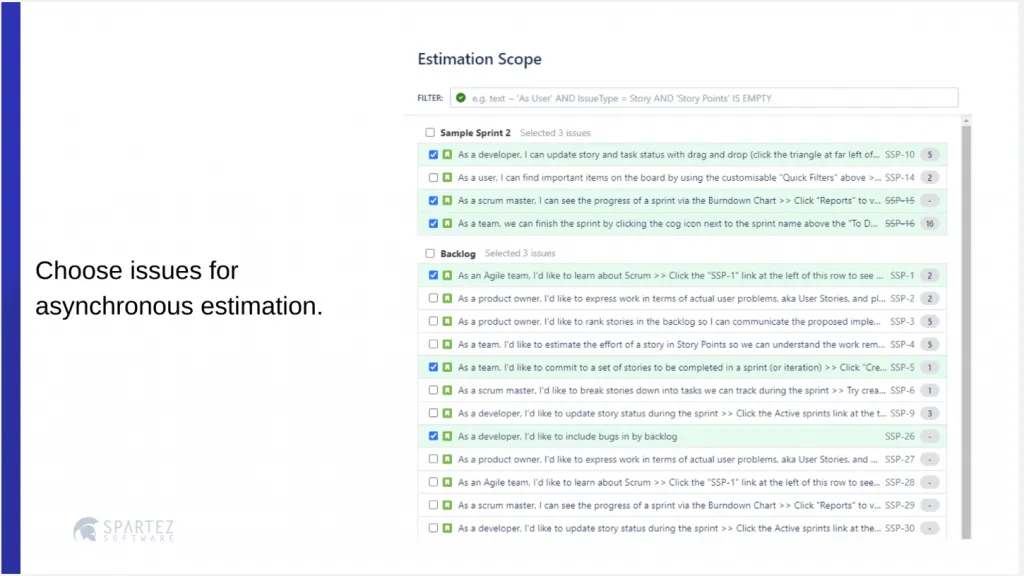
Access to Product Backlog and full sync with your estimations results
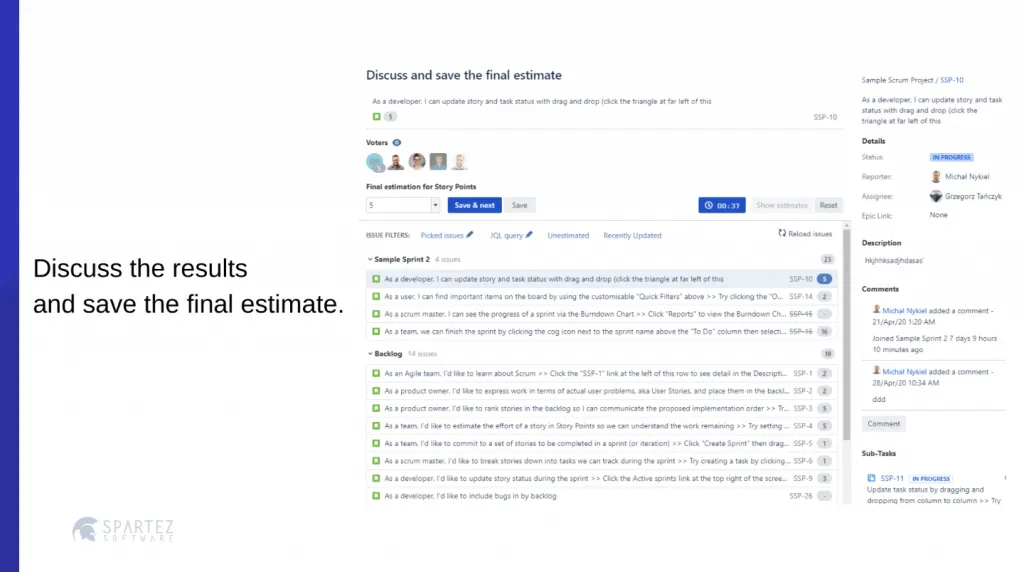
With Agile Poker, you have a full synchronization checkbox already completed. You can edit, update, and insert estimation results into Backlog Items straight in Agile Poker during the estimation session giving the visibility of all inputs to your teammates and the whole organization.
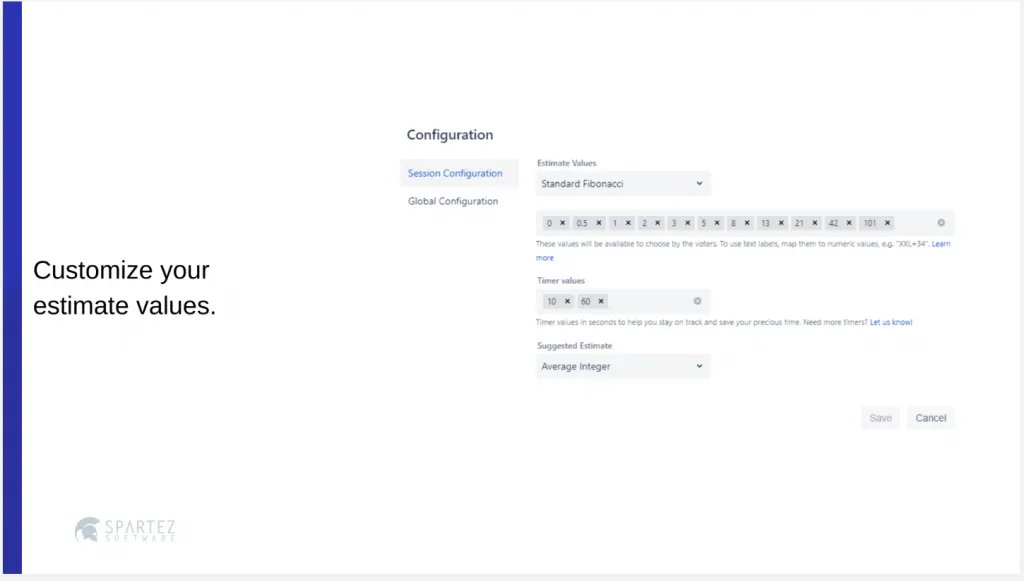
Customize your estimations to your team's needs
Agile Poker gives you the flexibility to choose estimation values that will fit your team's preferences. You can adjust and use multiple methods based on lessons learned from your previous estimations. Save and share your customized estimations values and allow other teams to use the same approach.
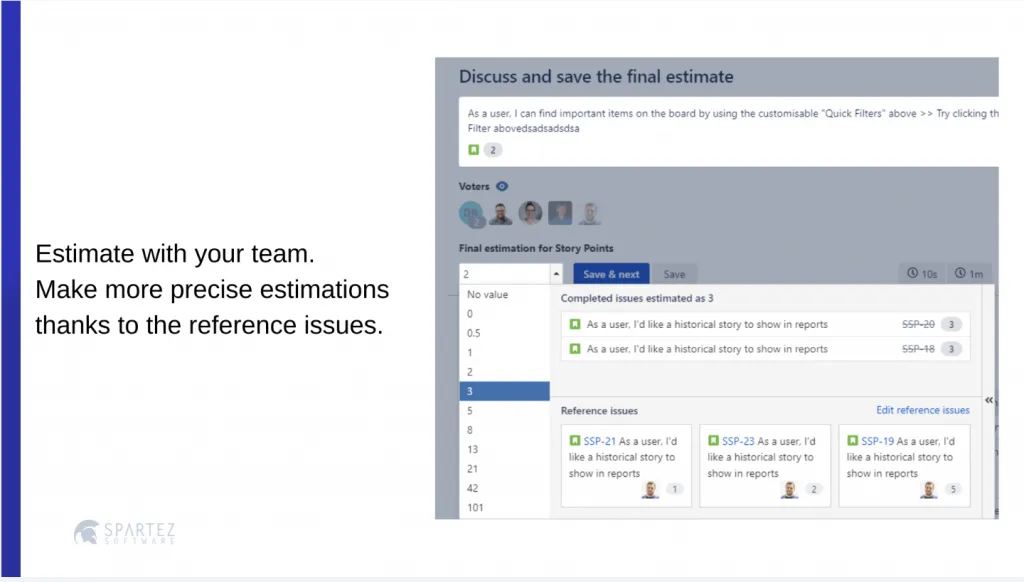
Estimation based on the reference issues
To have reliable estimations for the Backlog Items that were already delivered, try to estimate based on how much effort it cost in the past. Reference Issues could be viable primarily for teams working in big companies or on complex projects as the knowledge flow can be limited between teams there.
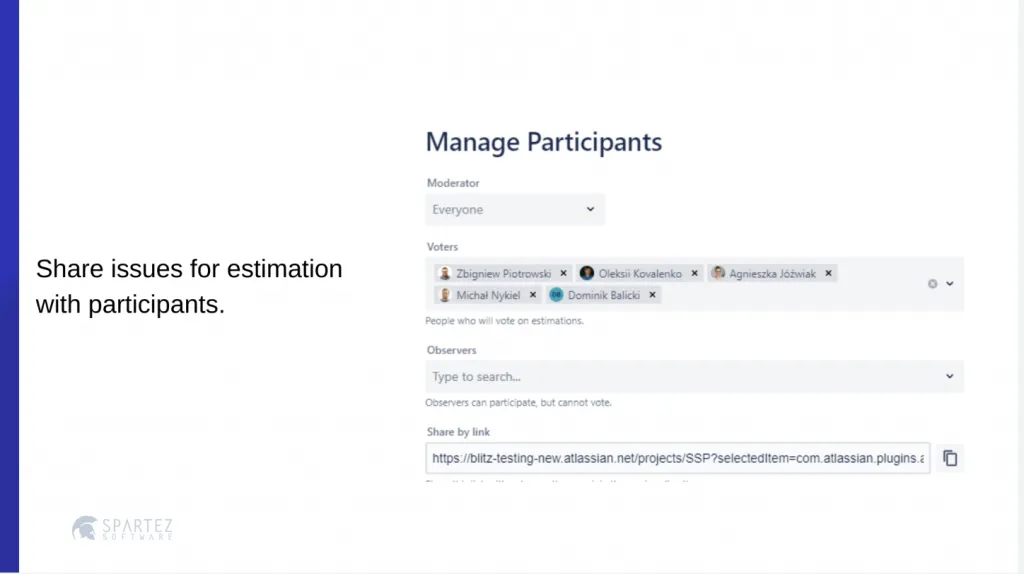
Remote or Distributed Teams have the same access to all information for each Backlog Item
Your team has all the information needed to estimate Backlog Items available in Agile Poker before and during the estimation session. Thanks to that, distributed or remote teams can estimate the same way as co-located teams. Agile Poker is synchronized with your Product backlog in Jira, so every update is instantly visible to the team members.
Estimation results are added to the Backlog Item after finished voting
No more summaries, no more notes - all your estimations will be added to your Backlog Items right after your team is done with the estimation session.
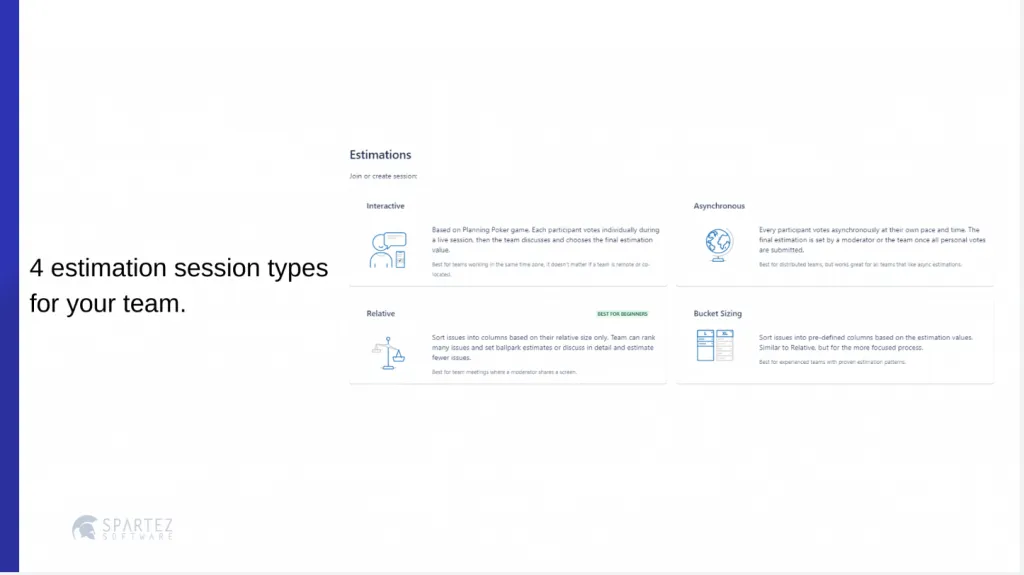
Four Estimation modes at your disposal
With Agile Poker, you can adjust or change the estimation method to your team's needs and the way you prefer to perform the estimations. You can estimate your Backlog Items using four different methods with customization options and tweak them to your team's particular needs at the time.
Learn more about the product here, or try Agile Poker in action for free.
Try Agile Poker free