
TL;DR
- The gap between boardroom strategy and day-to-day Jira execution widens as organizations scale. We call it the scale gap, and it's where strategic intent quietly gets lost.
- Traditional project portfolio management (PPM) keeps teams shipping, but it can't answer the questions leaders start asking at scale: what to fund, what to pause, and whether the work still matches the strategy.
- Strategic portfolio management (SPM) closes that gap. BigPicture Advanced brings a strategic layer into Jira itself: OKRs, prioritization, and financial governance, so teams don't have to leave the tools they already trust.
- For partners, learning to spot a customer's scale gap turns routine Jira conversations into strategic advisory opportunities, and opens the door to SPM implementation and migration planning.
Somewhere between the annual strategic plan and this week's to-do list, a lot of context gets lost.
That's not a failure of any one team. It's what happens when an organization grows past the point where a program or portfolio hierarchy can show the whole picture. The teams are still delivering. The backlog is still moving. But the connection between what leadership decided and what's actually happening in Jira gets thinner every quarter, until nobody can say with confidence that the work matches the strategy.
The layer that’s missing has a name in project portfolio management (PPM) circles: strategic portfolio management, or SPM. And if you sell, implement, or advise on Jira, it's worth understanding, because more of your customers are running into it than you might think.
What is strategic portfolio management?
Project portfolio management gives teams a way to plan, schedule, and track work across multiple projects. It answers questions like what are we building, who's building it, and when will it ship?
Strategic portfolio management asks an entirely different set of questions. Does this work still serve our strategy? Are we funding the right initiatives? Where is risk building up across the portfolio (and who's accountable for it)?
SPM doesn't replace PPM. It sits above it, connecting executive priorities, like OKRs (objectives and key results), budgets, and risk tolerance, to execution data, so what to fund, pause, or scale up depends on what's happening in Jira right now, not what everyone saw in the most recent quarterly slide deck.
Why Jira teams are outgrowing traditional PPM
A lot of organizations don't set out to build an SPM practice. They back into it because their PPM setup starts showing strain, indicating that it’s time to start exploring strategic portfolio management.
Four signs are common across growing organizations:
- Leadership can't trace daily Jira work back to the OKRs it's supposed to support.
- PMOs (program and project management offices) spend meetings reconciling spreadsheets instead of making decisions.
- Cross-team dependencies surface as a fire drill instead of a plan.
- Nobody has a clear view of capacity across teams, so people get over-committed and burn out.
None of that means a team is doing anything wrong. It means the organization has scaled past what project-level tracking alone can answer.
The scale gap: where strategy and execution disconnect
We call this the scale gap: the widening distance between what leadership decides and what teams can see and act on day to day.
It shows up gradually. One department starts using an Agile methodology while another runs waterfall. A new business unit merges its backlog into the existing Jira instance. An executive asks for a health report that used to take an afternoon and now takes a week, because the data lives in six different places. None of these is a crisis on its own. Together, they form a pattern, and that pattern is the scale gap.
We've mapped the specific warning signs for you in one place: the scale gap framework.
Explore the scale gap frameworkHow BigPicture SPM bridges the gap
BigPicture is Appfire's project portfolio management app, and BigPicture Advanced is the edition that adds strategic portfolio management (SPM) capabilities. Because it lives inside Jira, it closes the gap between strategy and execution without asking teams to abandon the workflows they already trust.
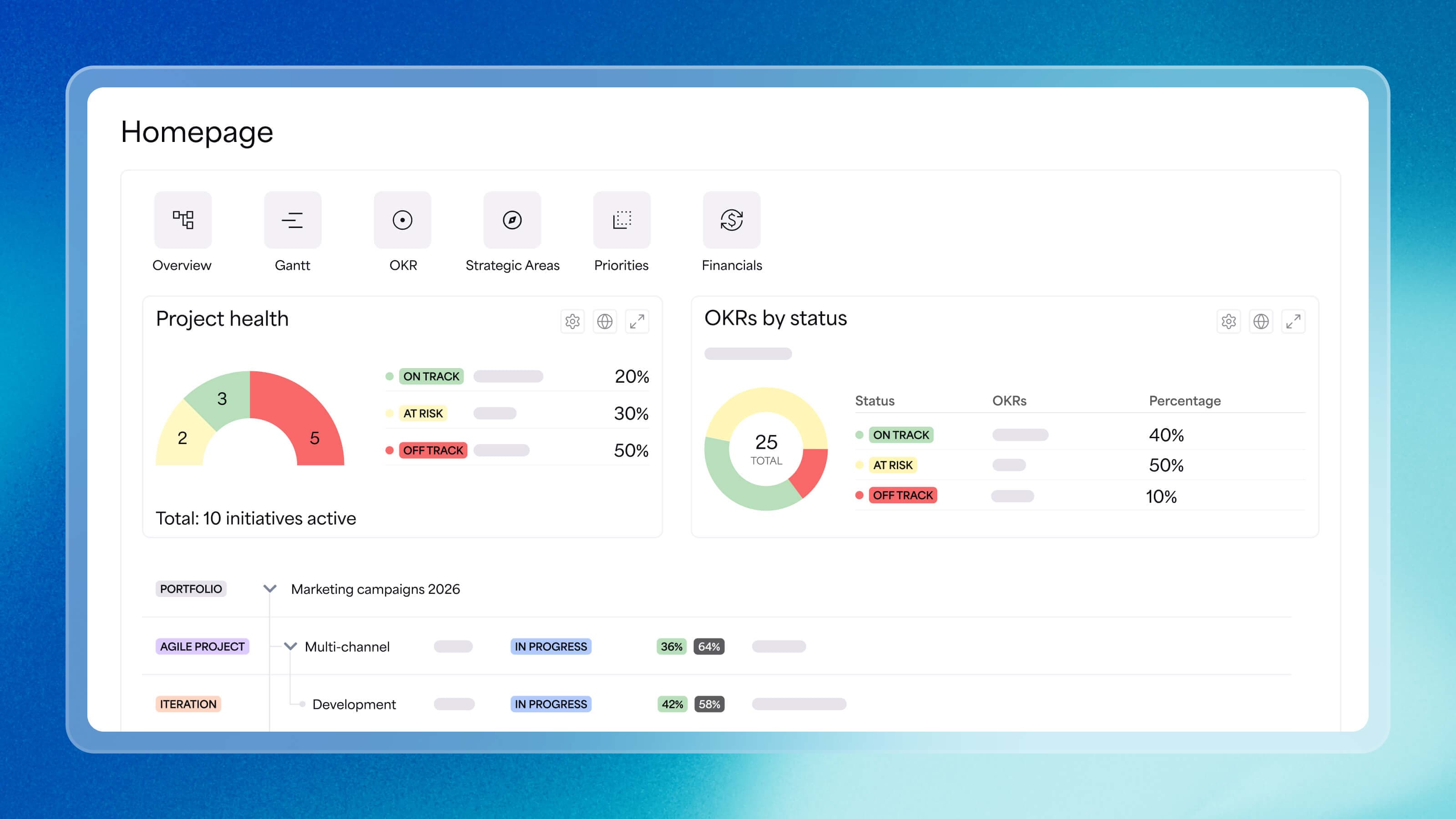
BigPicture Advanced extends BigPicture's existing project portfolio management capabilities with a strategic layer: OKRs that connect directly to Jira work, strategic prioritization that scores initiatives by impact, and financial governance that ties budget to delivery in the same system teams already use.
That means a PMO can show, in real time, which initiatives are tracking to strategy and which aren't, without stitching together a report by hand. It also means BigPicture doesn't force a single delivery methodology on the organization. Agile teams, waterfall teams, and hybrid teams can all report into the same portfolio view, on their own terms.
For organizations already using BigPicture Standard for PPM, moving to BigPicture Advanced is a natural next step, not a new tool to procure, learn, and migrate data into.
What this means for Appfire partners
If you work with customers on Jira, the scale gap is a conversation you're likely already having, even if nobody's named it yet. It's the moment a customer asks for a portfolio-level view, a governance model, or an OKR rollup that their current setup can't produce.
That moment is also an opportunity. Helping a customer recognize and close their scale gap moves the conversation from ticket configuration to strategic advisory, and it opens the door to services work: SPM implementation, migration planning, OKR integration, and ongoing portfolio governance support.
Appfire is building the resources partners need to lead that conversation with confidence, starting with the scale gap framework and a growing set of partner enablement materials, including the BigPicture Advanced (SPM) partner toolkit.
Access your BigPicture Advanced (SPM) partner toolkitFAQ
Is BigPicture Advanced (SPM) a different product from BigPicture Standard (PPM)?
No. BigPicture is one product. BigPicture Standard covers project portfolio management; BigPicture Advanced (SPM) adds the strategic layer, including OKRs, strategic prioritization, financial governance, and executive or advanced reporting.
Do we need to migrate to a new tool to use SPM capabilities?
No. Customers already on BigPicture Standard upgrade to BigPicture Advanced within the same app.
Does strategic portfolio management require everyone to work in Agile?
No. BigPicture works across Agile, waterfall, and hybrid delivery models, so adopting SPM doesn't require standardizing on one methodology first.
Who should read the scale gap framework?
Anyone advising a customer whose Jira setup can no longer answer strategic questions about their portfolio: PMO leads, delivery leads, and the partners who support them.
Where to go next
Strategic portfolio management is a big topic, and this is the starting point, not the whole story.
See how BigPicture closes the scale gapPartners can also access the BigPicture Advanced (SPM) partner toolkit and the scale gap framework infographic directly in the Appfire Partner Portal.
Related reading