

To accurately measure project performance, you need the right metrics. That’s where key performance indicators (KPIs) come into play.
Selecting the right KPIs is crucial. Here’s a list of 9 go-to project management KPIs, along with tips on how to measure them and their value for your projects.
What are project management KPIs?
A KPI is a quantifiable measurement that evaluates the performance of critical business objectives.
Businesses use many different KPIs. However, not all of them are suitable for project management. Different teams — like marketing, finance, or product development teams — have their own indicators, but project managers need metrics that reflect their specific goals.
9 essential KPIs for project management
1. Planned Value (PV)
Planned Value estimates the cost of your remaining project activities at the time of reporting. It helps you know if you’re over budget at a certain project stage.
Here’s how you can calculate the planned value of your project:
Planned Value = [% of scope remaining] X [project’s budget]
Let’s say 60% of the project is complete, and the budget is $100,000. To calculate the PV, you use the remaining 40% and multiply it by the $100,000 budget. Your PV is $40,000.
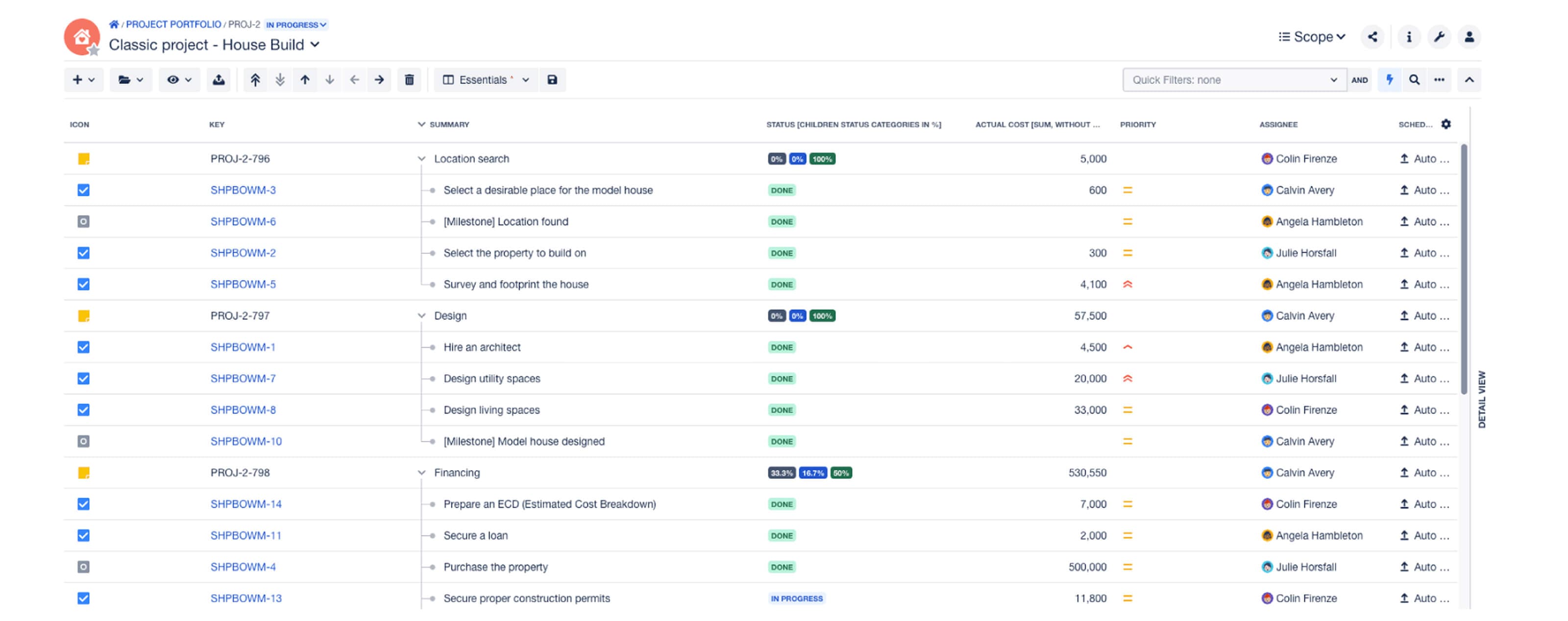
But that only tells you how much there should be left to spend at this stage. So, how do you determine if you’re on track? Compare PV with the Actual Cost of the project to check if you’re on track. BigPicture can log and track this in a dedicated column.
2. Budget Variance (BV)
Also known as Cost Variance (CV), Budget Variance compares your estimated budget to actual spending.
Budget Variance = Budgeted Cost of Work Performed (BWCP) – Actual Cost of Work Performed (ACWP)
If the result is more than 0, you’re spending less than anticipated.
If the result is less than 0, you’re spending more than estimated.
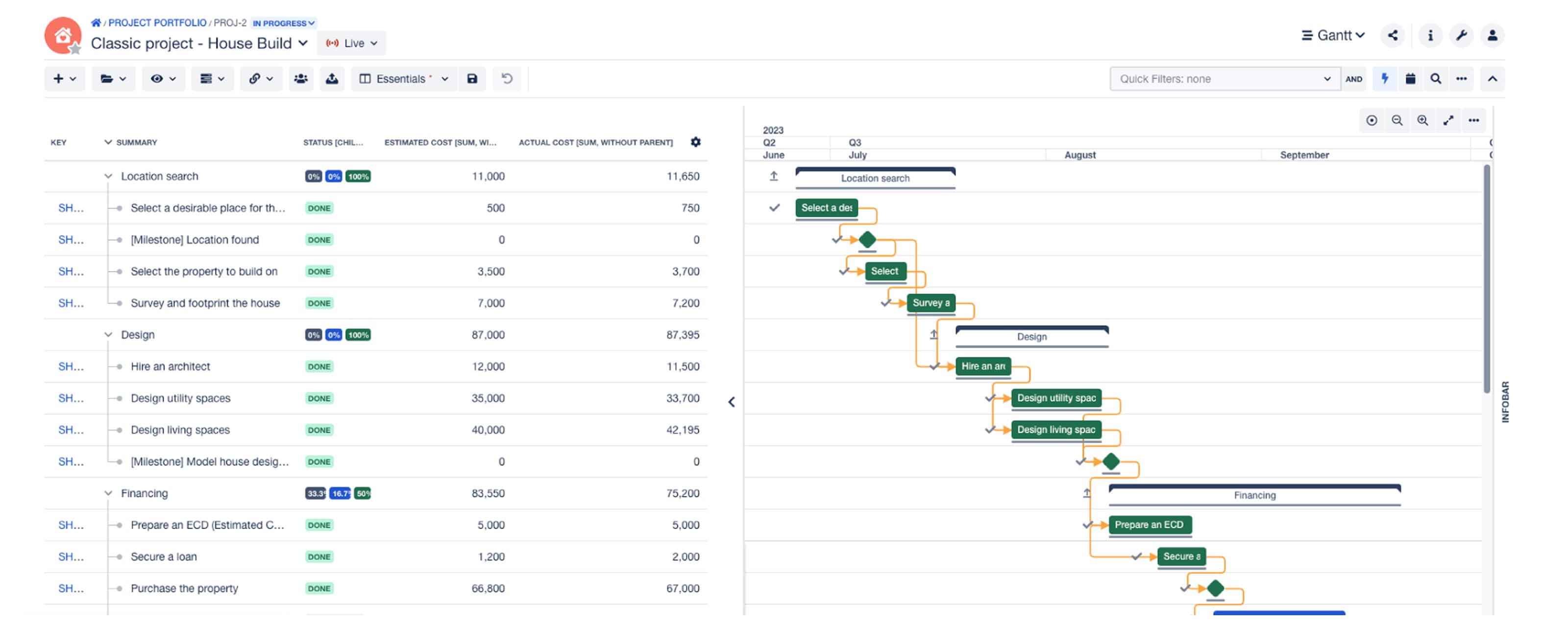
Budget Variance helps you verify if your spending is on the right track throughout the project’s life cycle. In BigPicture, you can compare both values for each task, phase, or whole cycles.
3. Schedule Variance (SV)
Schedule Variance measures if the project progress is on schedule, comparing the budget spent to the planned budget at a specific time.
Schedule Variance = Earned Value (EV) – Planned Value (PV)
Let’s look at an example: a project scheduled for 12 months with a budget of $250,000. Halfway through, you should have spent $125,000. That’s your planned value.
But when you add up the actual costs, you realize that you’ve only spent $100,000 in that period. Now you know your earned value. So, for this example:
$100,000 – $125,000 = –$25,000
A negative Schedule Variance value means that the project is behind schedule. Conversely, a positive SV would indicate the progress is ahead of schedule.
4. Return on Investment (ROI)
Is your project worth the effort? And if so, how do you evaluate it? ROI helps determine if the project’s value outweighs its cost.
But since profits aren’t usually realized in advance, you might have to rely on estimates. Here’s how you measure the ROI of your project:
ROI = [(Financial Value – Project Cost) / Project Cost] x 100
5. Cost Performance Index (CPI)
Cost Performance Index measures your project’s financial efficiency.
In other words, it lets you know if you’re sticking to your planned spending — or you’re falling short. To calculate CPI, you’ll need to know the Earned Value (the percentage of work completed multiplied by the budget).
Say you’re four months into a one-year project with a budget of $200,000. To calculate the EV, you need to multiply the budget by the progress: $200,000 X 25% = $50,000. Then, divide it by the Actual Cost you’ve incurred so far, and you know the CPI.
CPI = Earned Value (EV) / Actual Costs (AC)
If the CPI is more than 1, you’re spending less than the estimate.
If the CPI is 1, your project performance is on track with the spending.
If the CPI is less than 1, you’re overspending compared to the estimate.
Checking the CPI periodically will help you assess the project’s financial health. It may also help you spot spending issues before they cause too much damage.
6. Customer Complaints
Quality often gets overlooked. And when you don’t measure quality, improving it in your product is challenging. But how do you measure it? One of the ways is to listen to the customers.
You don’t need a formula for this KPI. It’s just a sum of all the complaints in a given time.
Tracking this KPI works best when you compare results over time. Be it monthly or quarterly, if you see the number go down, your product satisfies the needs and expectations of your customers better than it did previously.
If you want to focus on multiple aspects of your product, you can divide customer complaints into various categories. For instance, you can track the number of bugs (a popular Agile metric) as one group and the software’s performance as another.
7. Time Spent
This one’s simple. It’s the total time all team members spend on the project. It’s worth tracking it together with the planned hours at various project stages. That way, you can see if the work takes longer than expected. If it does, you can identify potential causes and mitigate them.
And it’s not something you need to calculate manually. Software like Jira can calculate the values based on the user input.
For example, if an assignee changes their task’s status from “To do” to “In progress”, the time starts ticking. And it does so right until that person moves the task to “Done.”
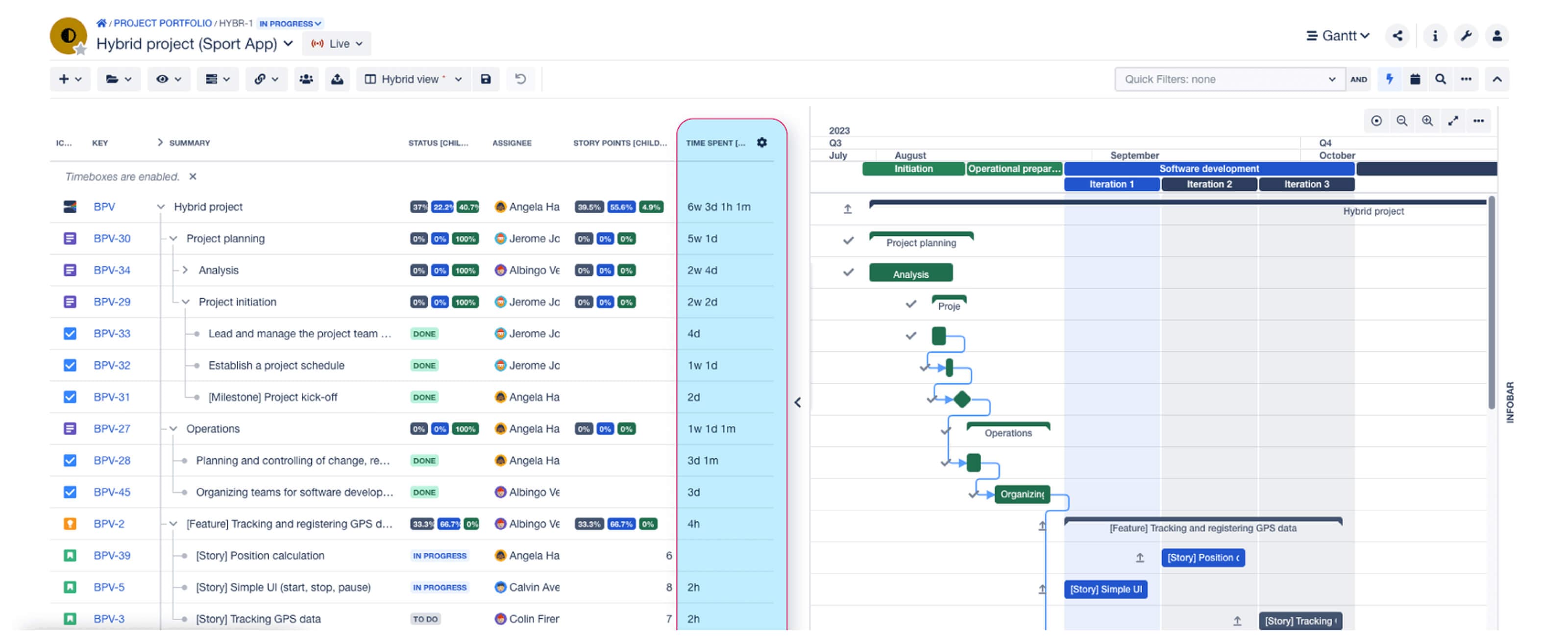
Jira can track the time spent on each task separately. But what if you want to see the time stats on a larger scale? You’ll need to generate a report every time. In BigPicture, the data is accessible much easier, and it’s always up to date. Plus, you can track time spent across projects, programs, or an entire portfolio.
8. Resource Capacity
Knowing how much work your project teams can take on is invaluable. And that’s whether you’re planning or monitoring the execution. Resource capacity shows your team’s availability for project work.
Monitoring this metric has a host of benefits, from supporting the proper allocation of resources and preventing work overload to maintaining alignment of the project schedules with resource availability.
Here’s how you calculate the capacity of your resources:
Resource Capacity = (Available work hours per day / Total number of workdays allotted to the project) X 100%
If the thought of doing all this math is making you yawn, don’t worry; the software can do it for you. With BigPicture, tracking capacity is easy. The Resources module gathers relevant data from Jira and displays it on a project or portfolio level.
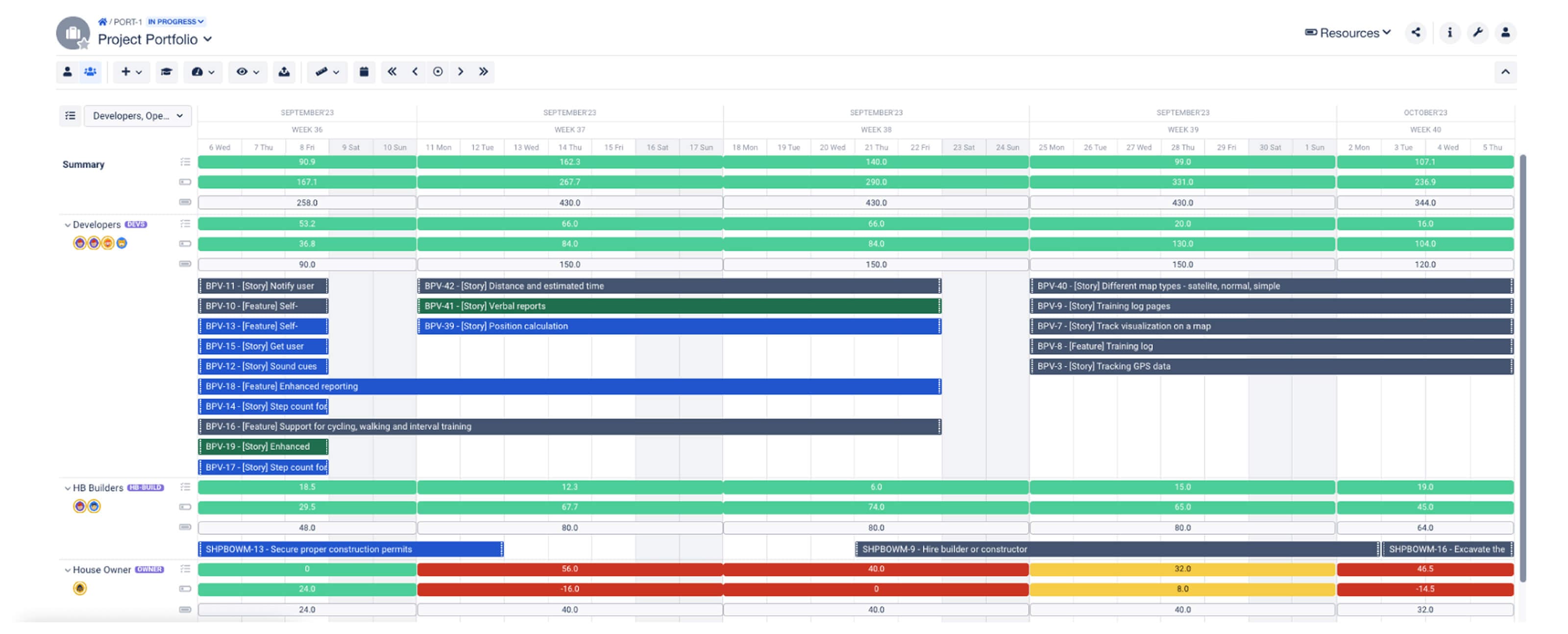
You can view the capacity of teams or individuals along with allocated work. Color-coded bars enable quick assessment of the allocation level, and the workload and remaining capacity fields provide specific information about each resource.
BigPicture also lets you calculate capacity by week, month, quarter, or half year. And aggregate the data daily, weekly, or monthly. If you manage Agile projects and use timeboxes (Sprints), you can also use them for data aggregation.
9. Percentage of tasks completed
This KPI helps assess your project’s progress. It’s a great indicator of how much work is left to deliver. As the name suggests, all you need is the total number of tasks and the number of tasks completed. Here’s the formula:
Percentage of tasks completed = (Total number of tasks / Number of completed tasks) X 100%
It’s one of the metrics you can track throughout the project — for instance, after each milestone, phase, or quarter. Checking this KPI regularly will help you stay on top of any delays and react before things get out of control.
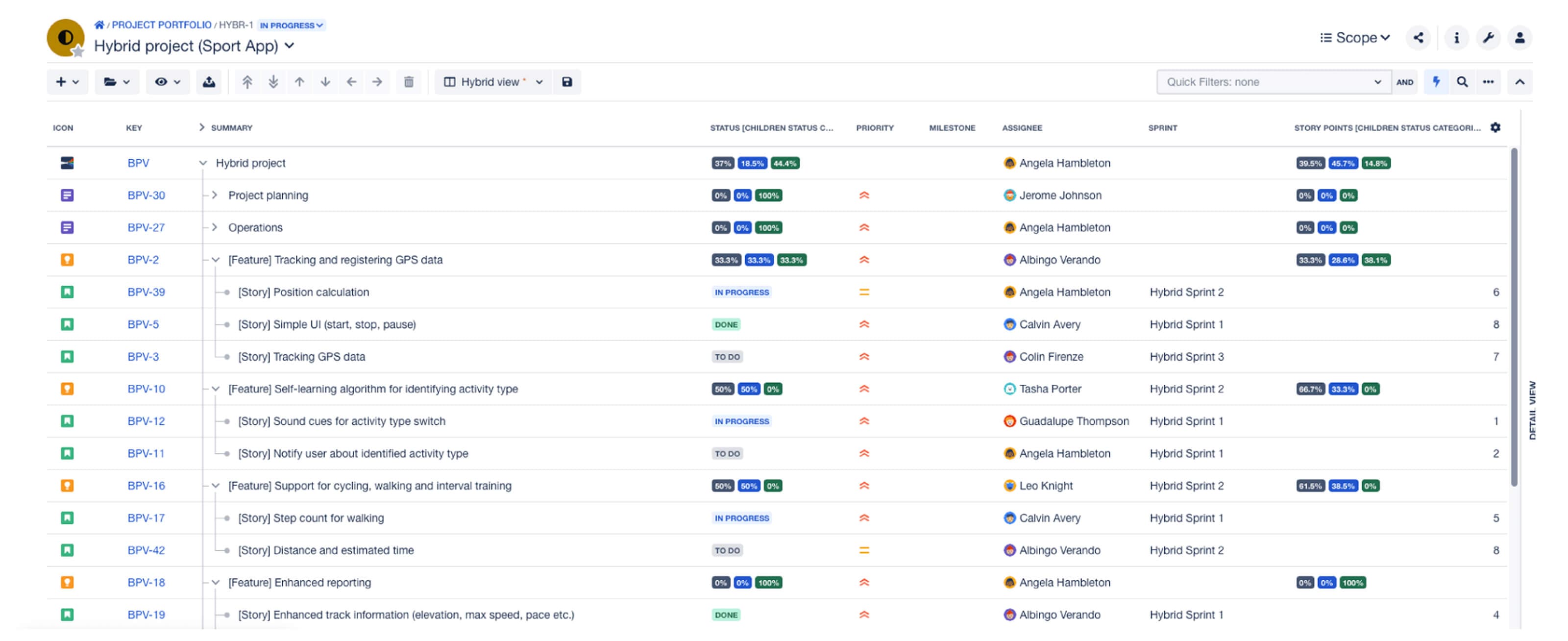
Track your project success with BigPicture
Maintaining a clear overview of your team’s performance and project progress is key. Leveraging the right software can greatly enhance this process. Appfire’s BigPicture is designed to simplify and optimize your progress tracking.
With BigPicture, data visualization and aggregation become seamless tasks. It adeptly handles a broad spectrum of KPIs, making the measurement of time, scope, and cost metrics more efficient than ever.
BigPicture excels at providing detailed visual insights at the project, program, or portfolio level, aiding in making well-informed, data-driven decisions.
Featuring robust two-way synchronization with Jira, BigPicture ensures a smooth data flow. Any changes made in BigPicture are reflected in Jira, maintaining consistent and reliable data across platforms.
Elevate your approach to product, project, and portfolio management with BigPicture, and discover a more straightforward path to gaining critical insights.
Try BigPicture for free