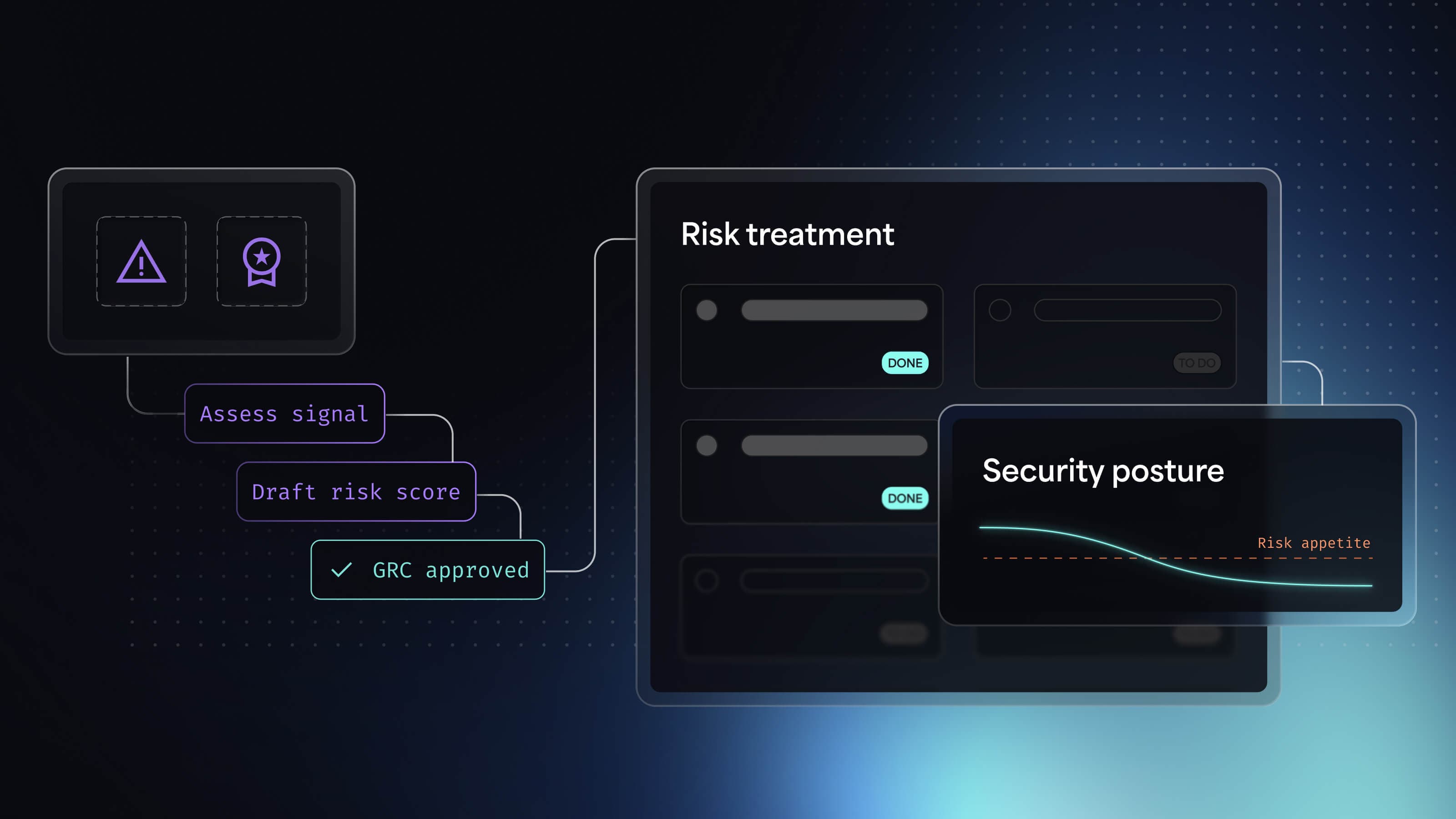

TL;DR
- Appfire LiveRisk is a Jira Cloud app for risk management that connects governed risks and security findings to treatment work, reassessment, and decision history.
- Security and GRC teams, the engineering, IT, and DevOps teams doing the mitigation work, and leadership all get a shared, current view of risk posture.
- AI provides objective feedback for risk scoring and treatment planning, reducing the subjectivity of traditional risk assessment while people remain accountable for decisions.
- LiveRisk works as a standalone Jira risk management workflow or alongside an enterprise GRC platform, and it's built for cybersecurity and GRC risk rather than project schedule risk.
What is our risk posture? What changed this quarter? Are we less exposed than we were in January?
These are simple questions for a CEO, CTO, or CISO to ask. They can be surprisingly difficult for security and governance, risk, and compliance (GRC) teams to answer, because the risk register, the security findings, and the Jira work meant to reduce exposure live in different places.
The risk register says treatment is underway. Jira shows some mitigation work is complete. Security tools keep generating findings. Meanwhile, GRC chases owners, reconciles updates, and tries to work out whether all that activity has changed the organization's exposure.
The problem isn't a lack of data. It's turning that data into an objective view of risk, and connecting it to the work meant to treat it.
Appfire LiveRisk brings those pieces together, so GRC can understand current risk posture, identify what needs attention, and connect those priorities to execution in Jira.
Why risk registers drift from reality
GRC teams spend much of their time on reactive work: questionnaires, audits, vendor reviews, and evidence requests. Risk management easily becomes another periodic exercise. A risk is identified, scored, entered into the register, and assigned a treatment. Then the record may sit untouched until the next formal review, while the environment, security signals, and mitigation work keep changing around it. The score itself may also depend heavily on individual judgment, leaving teams without an objective basis for comparing which risks deserve attention first.
When governance lives in one system and mitigation work happens across Jira projects, practitioners have to reconstruct the story by hand:
- Which finding or governed risk started the process?
- Does it apply to our environment?
- Which treatment decision was approved?
- Who owns the work, and is it progressing?
- What supporting records inform reassessment?
- Did residual risk change, and who accepted that decision?
When those connections break, leadership gets a point-in-time view, GRC spends its time collecting status, and delivery teams execute work without seeing how it connects to the organization’s risk priorities.
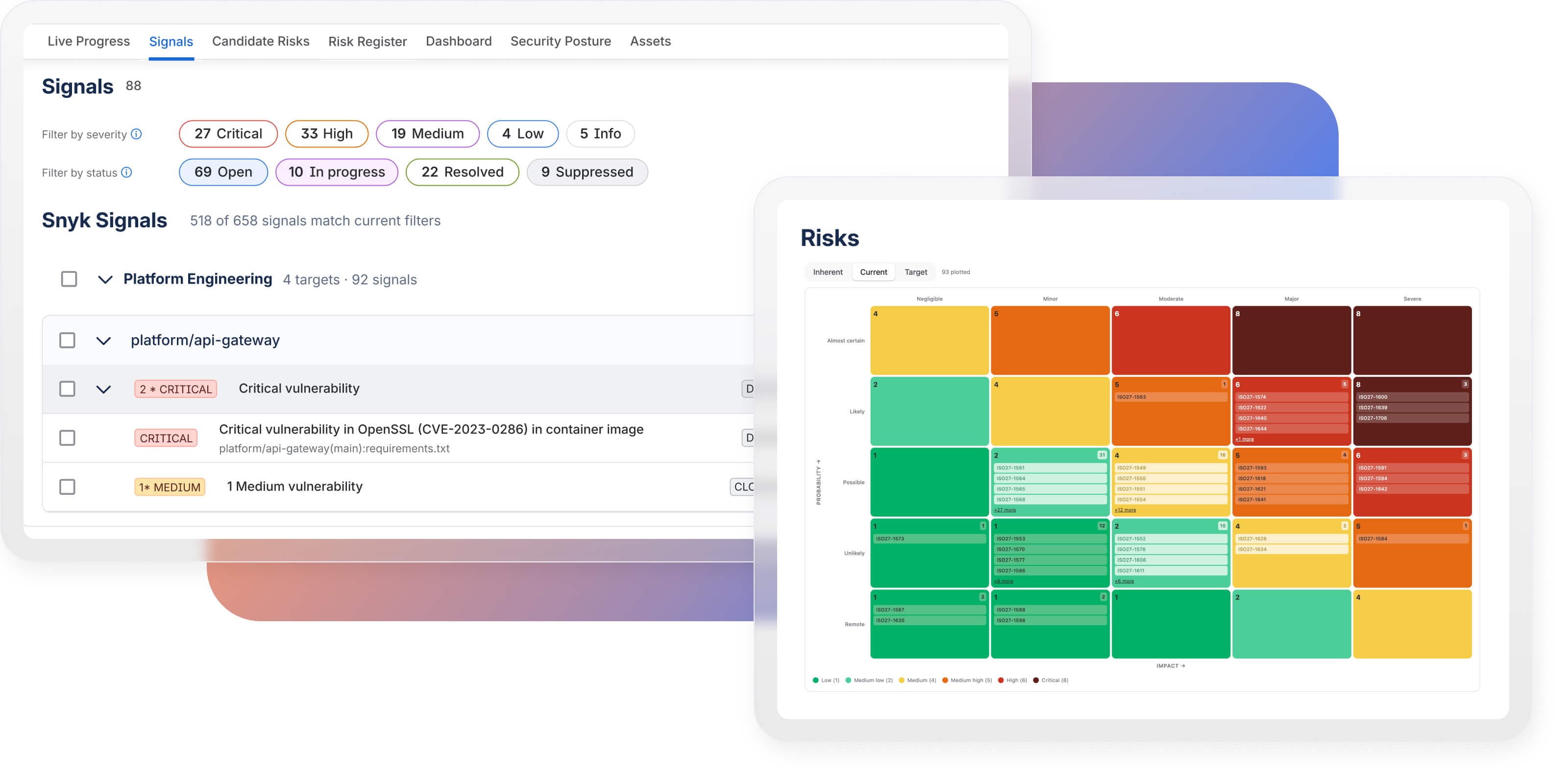
LiveRisk brings security signals and risk together in Jira, giving teams a clearer view of what needs attention.
What Appfire LiveRisk is (and who it’s for)
LiveRisk is a Jira Cloud risk management system that connects risk identification, assessment, treatment, execution, and re-evaluation in one workflow. It uses signals and organizational context to help teams identify and evaluate risk, then connects treatment directly to the Jira work used to address it.
LiveRisk isn’t a project risk register. It’s built for the organizational risks GRC and security teams manage, not the schedule or delivery risks of a single project.
- Security and GRC teams manage governed risks in Jira, connect them to treatment work, follow progress, and keep the history behind every accepted change.
- Engineering, AppSec, IT, DevOps, and operations teams keep mitigation work in the Jira projects and work item types they already use.
- Leadership gets a clear line of sight from where the organization is exposed, to where it wants to be, to what it’s doing about it, to what has changed.
Manage risk in LiveRisk, or connect your existing GRC platform
You don’t need to replace the systems that already govern your risk program.
Teams can run risk management in Jira directly in LiveRisk, with assessment, treatment, Jira work, re-evaluation, and decision history in one workflow.
Organizations that want to keep an enterprise GRC platform can also bring supported governed risks into LiveRisk and connect them to Jira execution. Governed risks from supported platforms come into LiveRisk and link to the Jira work used to treat them, while the broader GRC program stays where the organization chooses to manage it.
Either way, practitioners get a traceable connection between the risk, its context, treatment, execution, and reassessment.
How LiveRisk works
Turn security signals into candidate risks
Security teams rarely lack signals. The challenge is making sense of them. Thousands of individual findings can make it difficult to see which patterns point to meaningful organizational risk.
LiveRisk uses Atlassian Rovo to help make sense of that noise. Teams select relevant signals, and Rovo analyzes them to identify and suggest candidate risks for human review. Practitioners then decide whether to accept, refine, or dismiss the suggestion before it becomes a governed risk.
At launch, Wiz and Snyk provide findings as signals, and OneTrust supports a manual, one-way import of existing governed risks. LiveRisk doesn’t write changes back to those source systems. More integrations are planned.
The result is a clearer path from thousands of individual findings to the candidate risks that may actually require attention, with Rovo helping surface patterns and people making the final call.
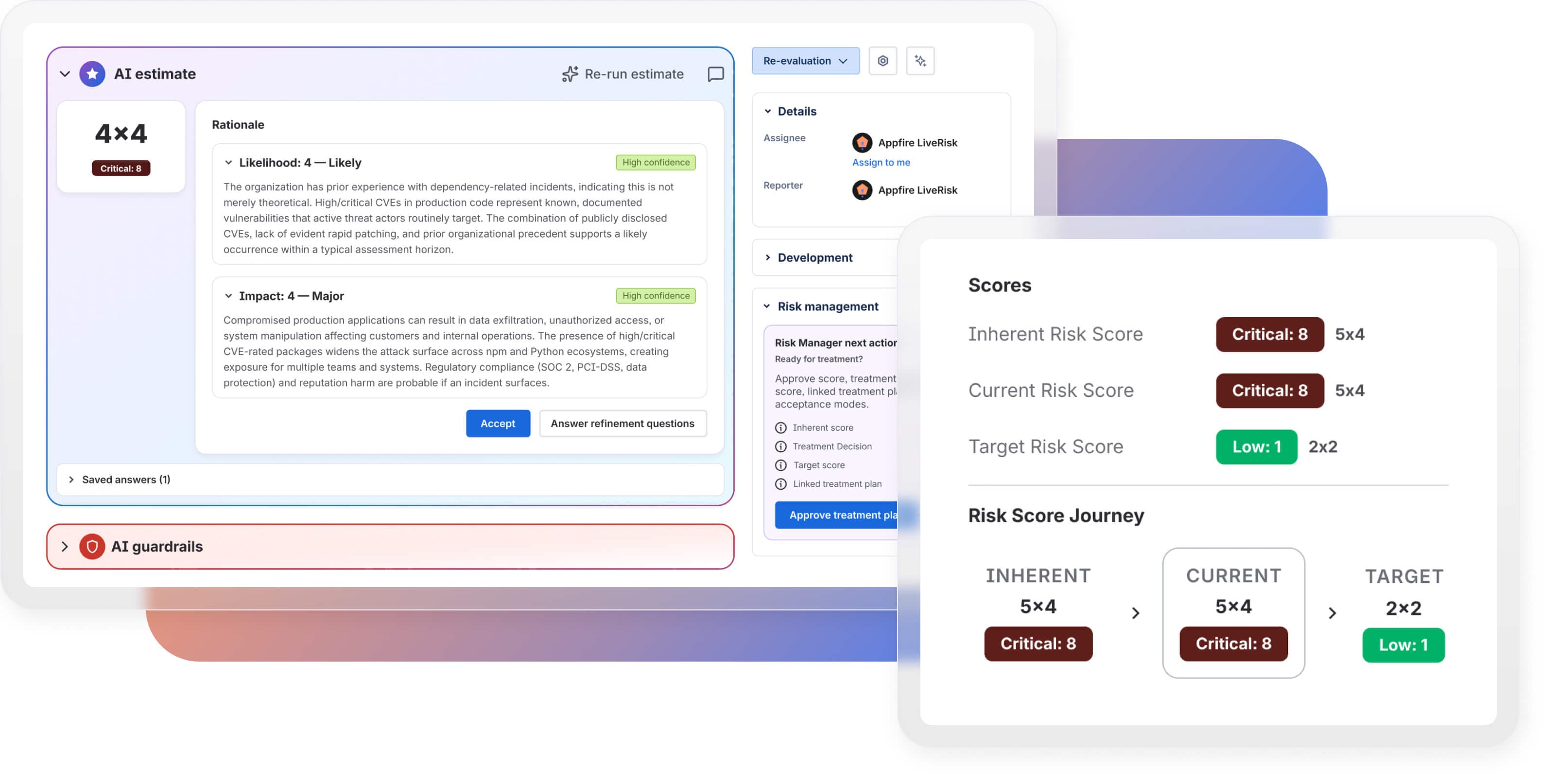
LiveRisk provides AI-assisted scoring with clear rationale, helping teams reduce subjectivity while keeping risk decisions in human hands.
Reduce subjectivity in risk scoring
Traditional risk scoring often starts with human judgment. Impact and likelihood can vary depending on who performs the assessment, what information they have available, and how they interpret it.
LiveRisk provides objective feedback grounded in available evidence and organizational context. Security findings, risk context, governed Confluence policies and documents, and the organization’s configured scoring model give AI more to work from.
AI recommends impact and likelihood with its reasoning attached and proposes treatment plans. Practitioners review, question, refine, accept, or reject those recommendations before they become governed decisions.
Once a practitioner accepts the inputs, LiveRisk calculates the score using the organization’s scoring model. Instead of relying on someone to arbitrarily choose a score, practitioners get a consistent, explainable starting point for the decision.
Turn an approved treatment into owned Jira work
A treatment plan only creates value when it turns into action.
LiveRisk helps practitioners draft a treatment plan, a target risk state, and the related Jira work. Practitioners review and refine the proposal, set ownership and timing, and approve the plan before work is created.
Once approved, treatment becomes owned work in the Jira projects where delivery teams already operate, while staying connected to the governed risk.
LiveRisk works as a risk remediation app inside Jira, giving GRC risk mitigation tracking from the decision through the work. The team can help set priorities and coordinate treatment instead of only documenting risk.
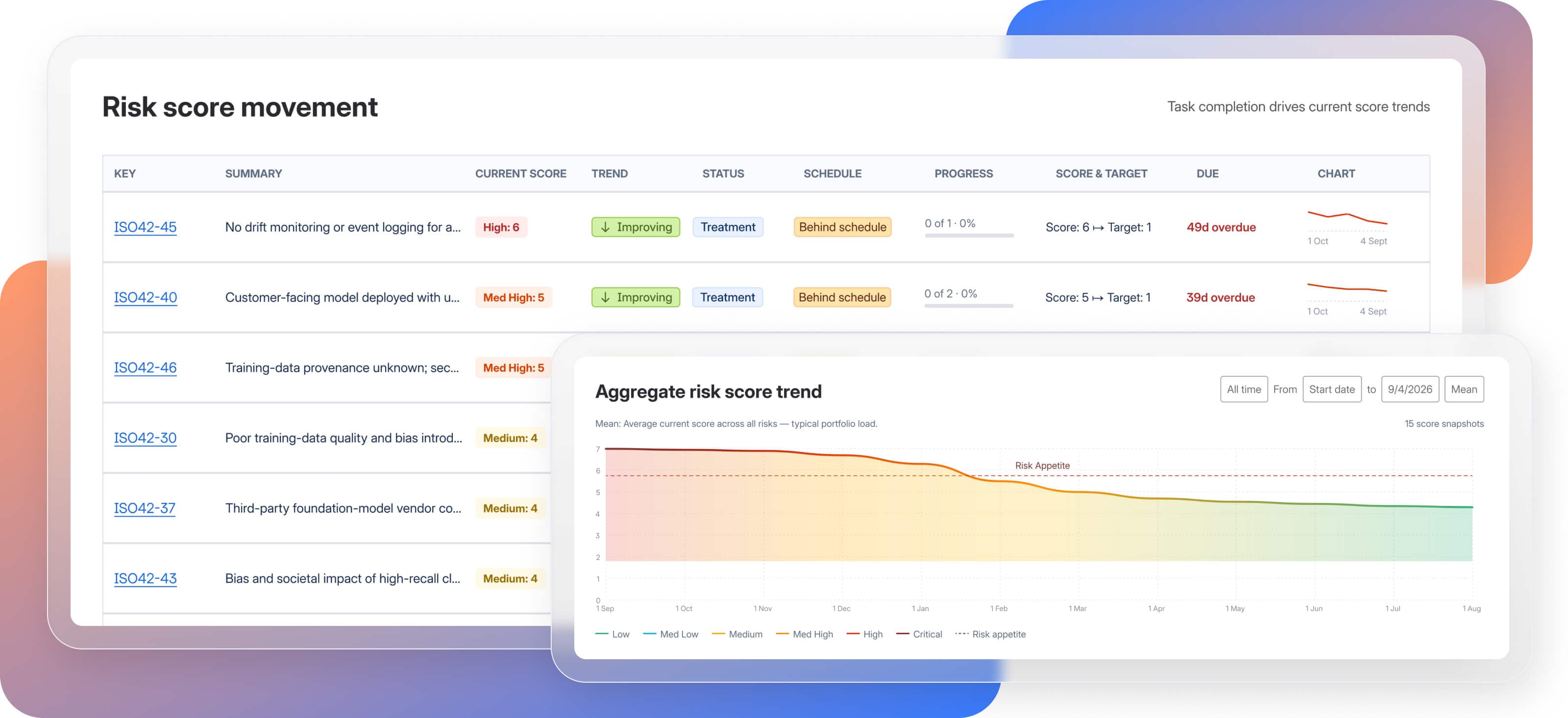
Track changing risk across the portfolio to see where risk stands and where attention is needed.
Track how risk posture changes over time
Periodic reviews often start with a scramble to determine what happened since the last assessment.
LiveRisk keeps treatment progress, current and target scores, score history, review dates, reassessments, and accepted decisions associated with the risk. Instead of quarterly reconstruction, you get continuous risk monitoring in a Jira app your delivery teams already use.
So when a CISO asks how the organization’s risk profile has changed since the start of the year, GRC has the answer ready. The team can show where exposure is highest, which treatments are progressing or stalled, and how the accepted risk profile has moved over the past quarter or year.
Completed Jira work doesn't automatically prove risk reduction. Changing a risk score still takes context, evidence, judgment, and accountable reassessment. LiveRisk puts that information in one place, so reassessment is faster and better documented.
Objective AI feedback, with people in control
AI assistance doesn't mean handing risk decisions over to AI.
Candidate risks require human acceptance. Key decisions, including the target residual risk score, treatment decision, and risk status, stay with people. Practitioners review and refine every recommendation before accepting it.
Teams can turn on bounded automation for an individual risk, but only after a person explicitly approves the automation and its controls. Jira records whether each change was made by a person or LiveRisk.
AI can accelerate the process. Accountability stays with people.
What to evaluate before connecting risk management to Jira
Start with one defined cybersecurity risk process and measure whether LiveRisk improves how your team runs it. Five questions help:
- Does Jira already hold the mitigation work? LiveRisk is designed for organizations that use Jira Cloud for security, engineering, IT, AppSec, or operational treatment work.
- Who owns the risk decision? A security or GRC sponsor should define the assessment method, treatment approval, reassessment process, and decision authority.
- Are the required sources supported? Check that the risk and finding sources you need are on the current integrations list.
- What evidence supports reassessment? Agree on the context practitioners need before changing residual risk. Task completion alone shouldn’t be the success criterion.
- Can leadership see the change? Check whether decision-makers get a clear view of current risk posture, target state, treatment progress, and the rationale behind accepted changes.
Useful evaluation measures include the time from approved treatment to owned Jira work, the share of material risks connected to treatment work, the age of overdue treatments, and the effort required to prepare a risk review. Establish a baseline first, so you have something to compare against.
Know where your risk stands and what you're doing about it
If your leadership team asked, “What is our risk posture, what has changed, and what are we doing about it?” how quickly could you answer?
See how LiveRisk helps teams identify and evaluate risk, connect treatment to Jira execution, and keep leadership current on risk posture as it changes.
Start your free trialFeatured products
