
Turn static Confluence pages into live dashboards with Dashboard Hub
TL:DR
- Dashboard Hub lets you embed live, interactive dashboards that stay in sync with Jira, Opsgenie, Bitbucket, Statuspage
- Skip the manual updates — charts refresh automatically, right inside your documentation
- Give stakeholders what they need, when they need it, without jumping between tools
- See if Dashboard Hub is right for you and your team today with a free trial — make reporting effortless
Why static Confluence reports slow down your team
If you’ve ever built a reporting page in Confluence, you know the drill: gather dashboard screenshots, paste them into a page, format everything just right…then do it all again next week.
Or maybe sooner, depending on how fast your metrics change.
That’s the thing about using static images to track live work: your Confluence dashboards become outdated the moment you hit publish. And the more tools you rely on — Jira, Opsgenie, Bitbucket, Statuspage — the harder it is to keep everything aligned in one place.
Confluence is where teams go to share progress, communicate plans, and build visibility across the business. But if your data isn’t current, your team isn’t aligned.
What if your Confluence pages could stay in sync with your dashboards automatically?
How to embed live dashboards in Confluence with Dashboard Hub
This is where Dashboard Hub for Confluence changes the game.
With a simple macro, embed live dashboards or charts right into your Confluence pages — no screenshots, no manual updates, no tab-switching.
Whether you're building a page for sprint planning, executive reporting, or product documentation, Dashboard Hub brings your most important metrics front and center, right where your team is already working.
You can choose from over 70 gadgets and 10+ integrations (including Jira, Opsgenie, Bitbucket, and Statuspage) to create dynamic views of real-time data. Customize layouts, colors, and chart sizes to match your page, bringing polish and purpose to every report.
It’s everything you’d expect from a dashboard, inside the Confluence space your team already relies on.
Confluence dashboard examples for agile, ITSM, and product teams
Here’s how teams use live dashboards to move faster and stay aligned, without leaving Confluence:
- Agile teams embed real-time sprint progress and velocity charts directly into their Confluence pages. Instead of pasting screenshots from Jira, they can drop in live burndown charts and team dashboards that update automatically as the sprint evolves, keeping retrospectives and planning pages always current.
- ITSM teams use Dashboard Hub to visualize SLAs, incident metrics, and service health directly within their internal documentation. This means fewer toggles between tools and fewer questions about where things stand, because the data lives right next to the processes.
- Product teams build pages that tell a complete story, from roadmap progress to release metrics to customer feedback. Need to show adoption trends from Jira, deployment data from Bitbucket, or status updates from Opsgenie? With Dashboard Hub, it’s all embedded in context — no spreadsheets, no copying, no guesswork.
These aren’t workarounds. They’re living reports built on real dashboards, in the same space where your team already collaborates.
Step-by-step: how to add dashboards to Confluence using Dashboard Hub
Adding a live dashboard or chart to your Confluence page is faster than updating a screenshot, and you don’t need any setup ahead of time.
1. Start editing your Confluence page
Use the “+” menu at the top or type /dashboard (Cloud) or {dashboard (Server/Data Center) to find the Dashboard Hub macro.
2. Choose what to display
Embed a full dashboard or just a single chart. Select an existing dashboard or create one from scratch — all without leaving Confluence.
3. Customize the layout
Resize your chart, tweak the visual style, reorder segments, and apply layout blocks using native Confluence tools.
4. Edit anytime
Click the embedded dashboard to jump to Dashboard Hub. Make your updates, then return to your page with a single click. Your dashboard will stay live and in sync with your data — no refresh needed.
Once embedded, your dashboard appears directly in the page, fully interactive and always current.
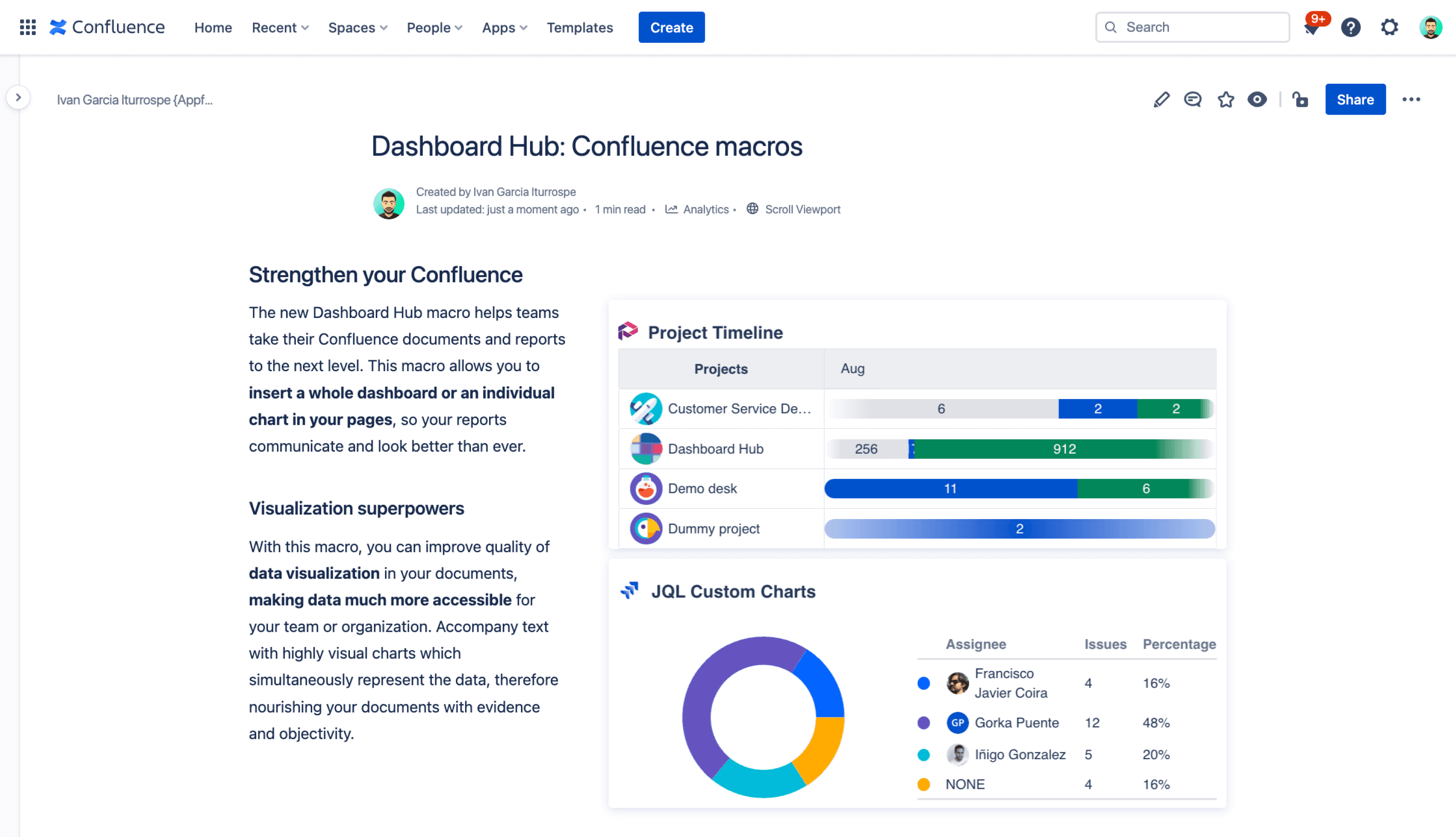
No switching tabs, no manual updates. Just live data, right where your team needs it.
Benefits of live Confluence dashboards over manual reporting
Static screenshots are fine until the data changes. Which it always does.
Screenshots go stale fast. They require constant rework. And they interrupt the flow of collaboration. Every update means jumping between tools, refreshing dashboards, pasting images, and hoping nothing breaks. It’s a chore you repeat weekly (or daily), just to keep your reports usable.
With live dashboards embedded through Dashboard Hub, that cycle stops.
Your pages stay fresh automatically. Charts reflect the latest metrics. And because everything lives in Confluence, your team — and your stakeholders — can get what they need, when they need it, no screenshots or status pings required.
No maintenance. No confusion. Just live reporting where your team already works.
Start your free trial of Dashboard Hub for Confluence
You don’t need to imagine how much better your Confluence pages could be — you can try it for yourself.
With Dashboard Hub, you can embed live, interactive dashboards and charts that keep your team aligned and your reports up to date. No more stale screenshots. No more manual refreshes. Just real-time data, right where you need it.
It takes just a few clicks to add your first dashboard — and once you do, you won’t go back.
Start your free trial of Dashboard Hub for Confluence and bring your reporting pages to life.
Try Dashboard Hub free