

TL;DR
- Sprint estimates shouldn’t feel like a guessing game — but they often do
- Start building estimates that are accurate, team-driven, and grounded in data
- Get clarity on story points vs. hours (and when to use which)
- Avoid the usual pitfalls like planning fallacies, scope creep, and gut-based guesses
- Use tools like Agile Poker for Jira and 7pace Timetracker to make estimating less stressful and more scalable
Sprint estimates are the backbone of Agile development, but if your sprints still feel like educated guesses, you're not alone. Even seasoned teams struggle to estimate work accurately. Complex requirements, shifting priorities, and hidden dependencies all make it hard to scope tasks precisely.
In this post, we’ll explore the importance of accurate sprint estimates, share best practices for creating them, explain the differences between story points and hours (and when to use each), and highlight apps that can improve your Agile process.
Why do you need accurate sprint estimates?
Accurate sprint estimates give teams a clearer picture of what can be accomplished within each iteration. By aligning tasks to the effort required and considering assumptions, requirements, and dependencies, teams can:
- Determine how many tasks to include in a sprint and distribute work evenly
- Coordinate workflows based on time, effort, and dependencies
- Assess requirements and identify risks in advance
- Avoid overcommitment by understanding team capacity
- Create reliable timelines to support business decisions, product launches, and marketing campaigns
The estimation process also provides a bird’s-eye view of the project, so you can see obstacles early and help teams plan effectively. By associating story points with time (or by estimating in hours), teams can better track velocity and plan sprints with greater accuracy.
How to create accurate sprint estimates
Create estimates as a team
In Agile, the people doing the work should be the ones estimating. Involving the entire team ensures diverse perspectives and improves the chances of accurately capturing all the tasks and complexities. Each member brings unique insights about the effort required, potential risks, and dependencies.
Pick the right software
Physical boards and sticky notes can work for co-located teams, but distributed teams need robust collaboration software. Look for apps that offer:
User story and task breakdown
The ability to break down projects into manageable user stories or tasks, estimating each based on size, complexity, and effort.
Team collaboration
Real-time features like shared boards, voting systems (e.g., Planning Poker), and comment threads so everyone can engage, regardless of time zone.
Historical data
Tracking past performance and making it accessible to the team for refining future estimates.
Support for multiple estimation techniques
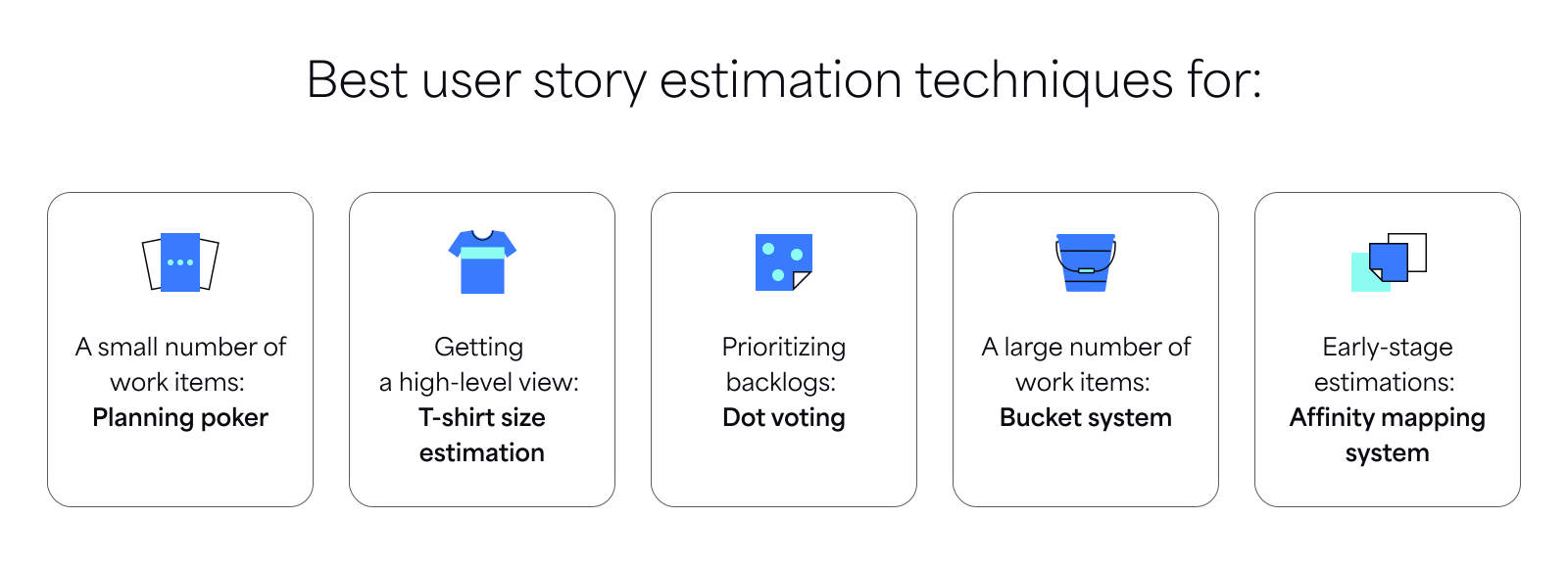
Options for Fibonacci sequence, T-shirt sizing, or story points to suit different team preferences.
Integration with project management tools
Integration with platforms like Jira, Trello, or Azure DevOps so estimates stay visible and connected to your broader workflows.
Establish and prioritize user stories
User stories represent features from a user’s perspective, providing a shared language for discussing requirements. Prioritize them based on value, cost, and risks. Some teams prefer to tackle high-risk items first to reduce uncertainties, while others aim to maximize value early.
Choose an iteration length
Sprint lengths typically range from two to four weeks. Shorter sprints allow for more frequent feedback and are often preferable when there are many unknowns.
Break down big tasks
If a task is estimated to take more than eight hours, split it into smaller chunks to improve accuracy. If that’s not possible, you can move some parts of the work to the backlog to avoid overburdening a sprint.
Update backlog items and release plans
Regularly review the product backlog, align priorities, and ensure all necessary resources are in place. After each sprint, update the release plan to capture lessons learned, revisit priorities, address new risks, and refine your estimates for upcoming work.
Skip agile estimation pitfalls
Even when teams follow the above steps, some pitfalls can derail your estimates:
- Applying one team’s pace to another. Velocity doesn’t always transfer between teams.
- Forgetting non-development tasks. Meetings, emails, code reviews, and bug fixes take time.
- Planning fallacy. Breaking tasks down into small steps helps reduce optimism bias.
- Confusing estimation with commitment. Adding buffers may help commitments but can hurt the accuracy of raw estimates.
- Ignoring technical debt. Maintaining and fixing legacy code can take longer as apps grow in complexity.
- Relying solely on gut feeling. Base estimates on data from previous sprints, not just a hunch.
Regularly reviewing historical data and refining estimates during retrospectives can help you address these challenges and improve accuracy over time.
Nail your estimates with Agile Poker for Jira
For teams using Jira, Agile Poker for Jira improves the estimation process by involving all team members:
Live and asynchronous modes
Collaborate in real-time or asynchronously across time zones.
Multiple estimation techniques
Use Fibonacci sequence, T-shirt sizing, bucket system, or custom values.
Session analytics, sprint velocity, and capacity calculators
Get insights into team performance to plan sprints with greater confidence.
Easy Jira integration
Keep estimation data connected to user stories and tasks within Jira.
Whether your team is scattered across continents or in the same building, Agile Poker for Jira can improve how you manage sprint estimates.
Story points vs. hours: How to choose the best sprint estimation method
Accurate estimates are crucial, but you can estimate them in more than one way. Typically, Agile teams lean on either story points or hours. Each method has distinct advantages and is better suited for certain situations.
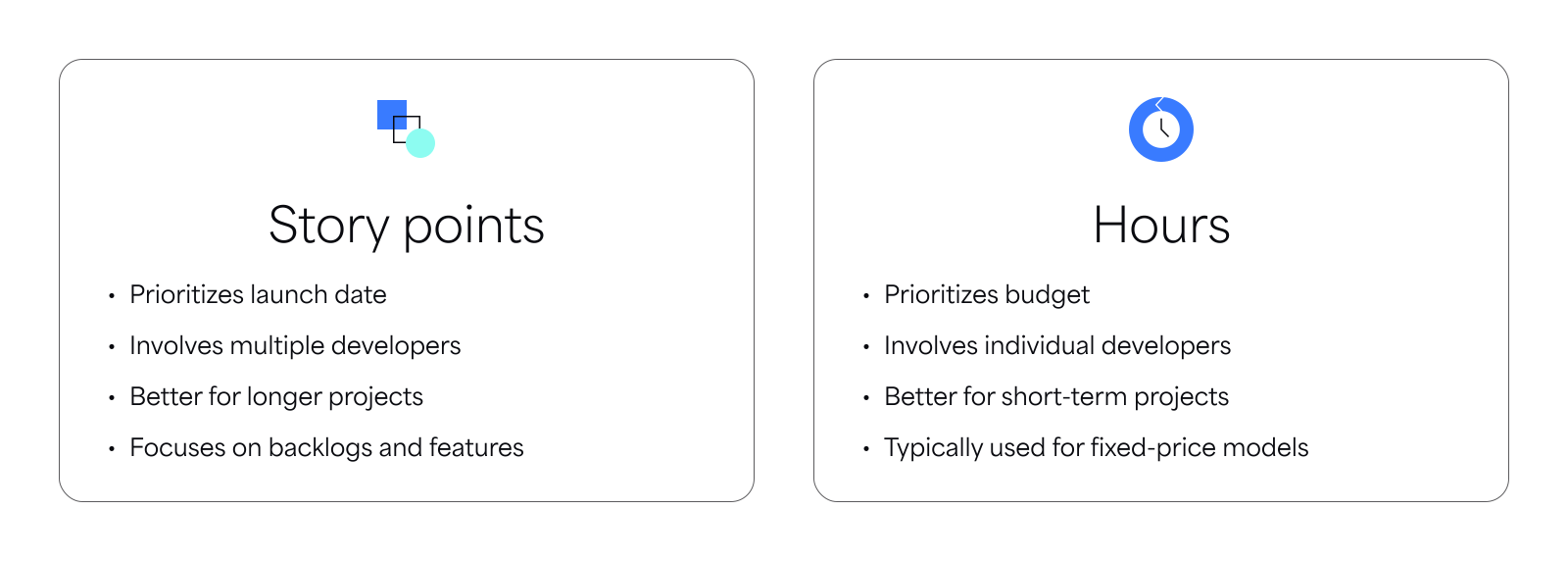
Story points in a nutshell
Story points are a relative estimation technique. Teams rate tasks based on their complexity, work required, and risk. They often use the Fibonacci sequence (1, 2, 3, 5, 8, 13…), which helps teams approximate rather than aiming for absolute precision.
Pros:
- Encourages team-based estimates rather than tying tasks to a single developer
- Helps track velocity sprint over sprint
- Adjusts easily to different levels of complexity or risk
Cons:
- May be less accurate when facing brand-new features or unfamiliar technical territory
- Doesn’t map neatly to exact budgets or non-development tasks
Using hours for estimation
Estimating in hours feels intuitive – especially to stakeholders outside of development. It’s straightforward for budgeting and can help identify resource gaps.
Pros:
- Easy to explain to managers and executives
- Familiar method when you have a clearly defined scope
- Simplifies budgeting
Cons:
- Tied to individual developers’ speed: If the team changes, estimates might shift
Large or uncertain projects can be harder to scope precisely - Adjusting timelines mid-project is more difficult
So, which is better?
Use story points if:
- You’re more concerned with delivery timelines than strict budget control
- You have a long project with many backlog items
- You need to track velocity closely and handle multiple dependencies
Use hours if:
- You have a shorter project with clearly defined tasks and limited resources
- Staying within budget is paramount
- You want to minimize the complexity of sprint planning
Why not combine both?
Some Agile teams take a hybrid approach: Using story points for relative estimation and tracking hours to measure actual time spent. A hybrid approach gives you the best of both worlds — planning flexibility and time-tracking precision.
Apps like 7pace Timetracker for Azure DevOps can help teams correlate story points with hours:
- Pace = tracked time ÷ estimated story points

- Time required = pace × story points

As a team’s pace becomes more predictable, these metrics provide early warnings when tasks deviate from estimates. This helps you adjust plans mid-sprint and drive continuous improvement.
Increase the accuracy of your data with 7pace Timetracker
If your team manages work in Azure DevOps, 7pace Timetracker captures detailed time logs and automatically ties them to user stories. By analyzing real-time data, you can:
- Spot trends and improve estimates based on past performance
- Approve timesheets and track team data in a single place
- Create custom widgets to monitor story points, bugs, and other metrics
Try 7pace Timetracker free for 28 days and see how it can elevate your sprint planning and execution.
Conclusion
Mastering sprint estimates is equal parts art and science. By involving the entire team in the estimation process, choosing the right software, and leveraging historical data, you can achieve more accurate forecasts that drive better results. Whether you use story points, hours, or a blend of the two, focus on continuous improvement and let data guide your retrospectives.
With apps like Agile Poker for Jira and 7pace Timetracker, you can improve both the estimation process and execution, so your teams have the visibility and accuracy they need to deliver on time — and on budget.
Try Agile Poker for Jira for free